

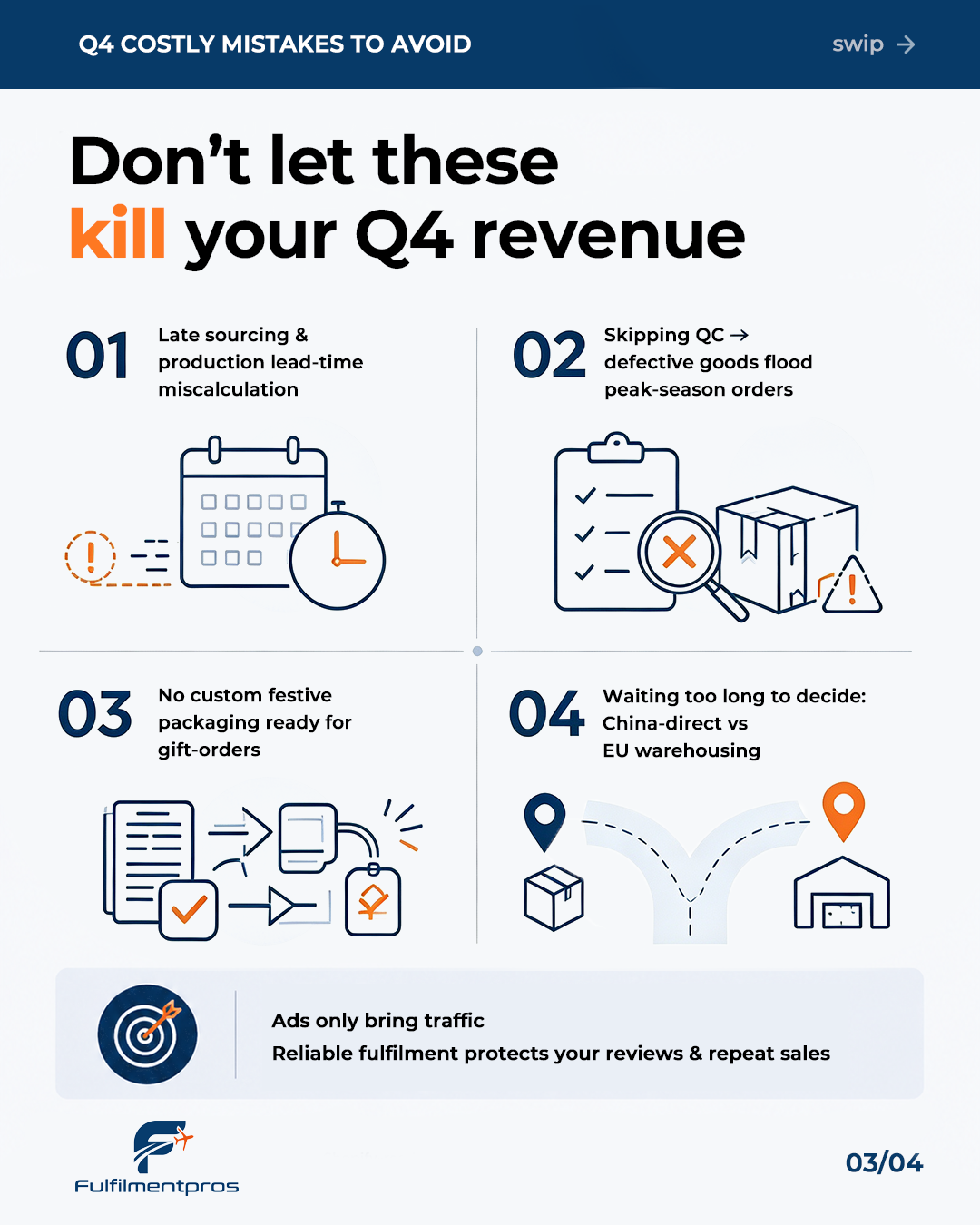

Q4 Ecommerce Fulfillment Planning: Costs, Inventory & Peak Season Readiness
Q4 can bring ecommerce brands their strongest sales opportunities of the year—but higher order volume does not automatically mean higher profit. Expensive shipping, excess inventory, warehouse bottlenecks, and late deliveries can quickly erode the value of a successful holiday campaign.
For US ecommerce and DTC brands, effective Q4 ecommerce fulfillment planning starts before Black Friday and Cyber Monday. Businesses need a clear view of profitability by SKU, realistic inventory forecasts, sufficient warehouse capacity, and a fulfillment strategy that can handle demand fluctuations without unnecessary costs.
This guide explains how to prepare your inventory, budget, and fulfillment operations for peak season.
1. What Are Ecommerce Fulfillment Costs?
Ecommerce fulfillment costs include the expenses required to store inventory, process orders, pack products, and deliver shipments to customers.
Depending on your operating model, these costs may include:
- Receiving: Unloading, counting, and processing incoming inventory.
- Warehousing: Storage space, inventory handling, and related facility charges.
- Pick and pack: Labor and materials required to prepare orders.
- Shipping: Carrier charges, fuel adjustments, residential delivery fees, and applicable seasonal surcharges.
- Returns: Return shipping, inspection, restocking, and processing.
- Operational overhead: Fulfillment software, integration, and other applicable service fees.
For Q4, avoid using your average shipping cost from earlier months without checking seasonal pricing. Carriers publish peak-period surcharges and operating schedules that can affect your delivery budget. Review the applicable dates and services directly with your carriers. FedEx’s 2026 demand surcharges and UPS’s 2026 US holiday schedule are useful planning references.
The goal is not simply to find the lowest fulfillment rate. It is to understand your total cost per order and how that cost changes when volume increases.
2. How to Calculate Contribution Margin by SKU
A store-wide profit margin can hide unprofitable products. Before increasing holiday advertising spend, calculate contribution margin for each important stock-keeping unit (SKU).
A practical formula is:
Contribution Margin per Order = Net Revenue − Variable Costs
Variable costs may include product cost, payment processing, fulfillment, shipping subsidies, advertising attributable to the order, and expected return or refund costs. Avoid counting the same expense twice.
For example, consider a hypothetical product:
| Item | Per order |
|---|---|
| Net revenue | $60.00 |
| Product cost | −$18.00 |
| Fulfillment and shipping | −$9.00 |
| Payment fees | −$2.00 |
| Advertising cost per order | −$15.00 |
| Expected return costs | −$3.00 |
| Contribution margin | $13.00 |
The contribution margin is $13, or approximately 21.7% of net revenue.
These figures are illustrative, not industry benchmarks. Your actual costs will vary by product, package dimensions, shipping zone, carrier agreement, and return rate.
Run this calculation for your leading SKUs before launching promotions. A discount that increases orders but leaves little contribution margin may make your Q4 sales look impressive while weakening cash flow.
3. How to Forecast Q4 Inventory Demand
Inventory forecasting should combine historical performance with current business conditions rather than rely on last year’s sales alone.
Start with these inputs:
- Weekly sales by SKU from the previous holiday season.
- Recent sales velocity and conversion trends.
- Planned promotions and advertising budgets.
- Supplier lead times and replenishment reliability.
- Existing inventory, open purchase orders, and expected returns.
Adjust the forecast for changes in pricing, product availability, marketing, and customer demand. Separate bestsellers from slower-moving SKUs so that inventory investment reflects their different sales potential.
A useful starting formula is:
Reorder Point = Average Daily Demand × Replenishment Lead Time + Safety Stock
Suppose a product sells 20 units per day, replenishment takes 15 days, and you hold 100 units as safety stock.
Reorder point = (20 × 15) + 100 = 400 units.
When inventory approaches 400 units, the business should evaluate replenishment. This is a planning example, not a universal rule; actual safety stock should reflect demand variability, lead-time uncertainty, and the cost of a stockout.
Review forecasts weekly during peak season. If demand rises faster than expected, update purchase orders and fulfillment capacity before backlogs develop.
4. How to Prepare for Black Friday and Cyber Monday
Black Friday and Cyber Monday can concentrate demand into a short period. Preparation needs to cover the full order journey, from inventory availability to carrier handoff.
Before the promotion:
- Confirm supplier quantities, production timelines, and replenishment dates.
- Check inventory accuracy across your store, warehouse, and sales channels.
- Review packaging, shipping rates, and carrier collection schedules.
- Test order routing, payment processing, and inventory synchronization.
- Agree on realistic daily order-processing capacity with your fulfillment team.
During the promotion:
Monitor orders, available inventory, fulfillment backlogs, cancellation rates, and shipping exceptions. Set thresholds for escalating unexpected demand or delays.
After the promotion:
Reconcile inventory, review actual contribution margins, process returns, and compare forecast demand with actual results. Use these findings to improve your Christmas and year-end plans.
Do not promise delivery dates based only on checkout estimates. Confirm carrier deadlines and warehouse processing cutoffs before publishing holiday shipping promises.
5. How to Manage Seasonal Ecommerce Inventory
Seasonal inventory creates a balancing act: too little stock can mean missed sales, while too much can tie up cash in products that lose demand after the holidays.
Segment your inventory into three groups:
- Core products: Items with consistent demand throughout the year.
- Seasonal bestsellers: Products with predictable holiday demand.
- Experimental products: New or uncertain items that require cautious purchasing.
Prioritize replenishment for products with proven demand and healthy contribution margins. Use smaller test quantities for uncertain products when practical, and establish a clear markdown or exit plan for seasonal stock.
Inventory visibility is equally important. Track available-to-sell inventory, reserved units, incoming stock, and damaged or returned goods. If you sell across multiple channels, synchronize inventory to reduce overselling.
A reliable fulfillment partner can support inventory tracking and order processing, but brands should still define ownership, reporting expectations, and replenishment responsibilities.
6. How to Evaluate Warehouse Capacity
Warehouse capacity is more than the number of available storage locations. Your operation must have enough space, labor, equipment, and processing capacity to receive inventory and ship orders on time.
Evaluate four areas:
Storage capacity: Can the warehouse accommodate expected inventory without overcrowding or making fast-moving products difficult to access?
Receiving capacity: Can incoming shipments be checked and made available for sale before promotions begin?
Order-processing capacity: How many orders can the team pick, pack, and dispatch each day? Measure realistic throughput, not just theoretical maximums.
Shipping capacity: Are carrier collections, pickup schedules, and delivery services sufficient for projected volumes?
Build a daily peak forecast and compare it with confirmed operational capacity. Identify the gap early enough to adjust staffing, inventory placement, order cutoffs, or fulfillment arrangements.
A warehouse that can store all your products may still struggle to process a sudden surge in orders. Measure both storage and throughput.
7. When Should a Brand Consider a 3PL?
A third-party logistics provider (3PL) may be worth considering when your existing fulfillment setup cannot support growth efficiently.
Common signals include:
- Your team spends too much time picking, packing, and shipping.
- Storage or labor constraints limit sales growth.
- Inventory accuracy and order tracking are becoming harder to manage.
- Delivery delays or fulfillment errors are increasing.
- You need more predictable fulfillment operations without building additional warehouse infrastructure yourself.
Compare the full cost of in-house fulfillment with a 3PL proposal. Include storage, receiving, pick-and-pack fees, shipping, account fees, technology, returns, and any minimum commitments. Also evaluate integration capabilities, service-level expectations, peak-season capacity, and communication.
Fulfilment Pros supports ecommerce and dropshipping businesses with relevant services such as inventory management, supplier coordination, quality control, pick and pack, and order fulfillment, depending on business requirements.
The right partner should help you understand your costs, operational constraints, and growth needs—not simply offer a lower headline rate.
Build a Q4 Fulfillment Plan Before Demand Peaks
Effective Q4 planning connects three decisions: which products deserve inventory investment, how much profit each order contributes, and whether your fulfillment operation can deliver on customer expectations.
Start with SKU-level margin analysis, build a demand forecast, confirm supplier and warehouse capacity, and review carrier costs and holiday deadlines. Revisit the plan as actual sales data arrives.
If your current operation is approaching its limits, evaluate whether a more structured fulfillment setup can help you scale without losing control of costs and customer experience.
Planning for Q4 growth? Contact Fulfilment Pros to discuss your inventory, order volume, and ecommerce fulfillment requirements.